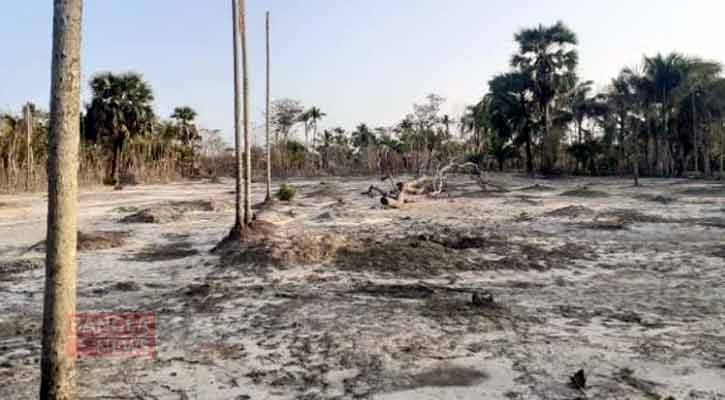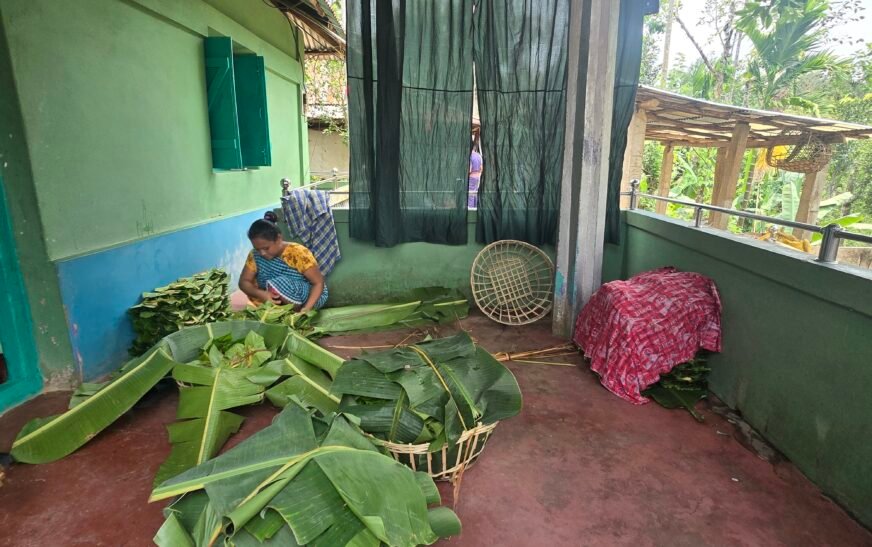
In the forested landscapes of Sreemangal in northeastern Bangladesh, mornings in Khasi villages begin with the sound of leaves brushing against bamboo frames. Women bend over betel vine gardens, checking each leaf, its growth, disease marks, and harvest readiness. This is not just agriculture. It is the foundation of their economy, identity, and survival.
But that rhythm, carefully tied to seasonal rain, is now breaking.
Khasi woman farmer Sabu Suting from Lauachara says, “We own the land, we run the garden. But now we no longer understand the rain.”
That uncertainty is becoming the most serious livelihood threat for Khasi women.
Across Khasi settlements in Sreemangal and surrounding forest areas, betel leaf cultivation depends on a fragile monsoon system that is becoming increasingly unstable. Scientific studies show that monsoon onset and withdrawal in Bangladesh has shifted significantly over recent decades, with variations ranging from 1 to 72 days, disrupting long established seasonal predictability. Source
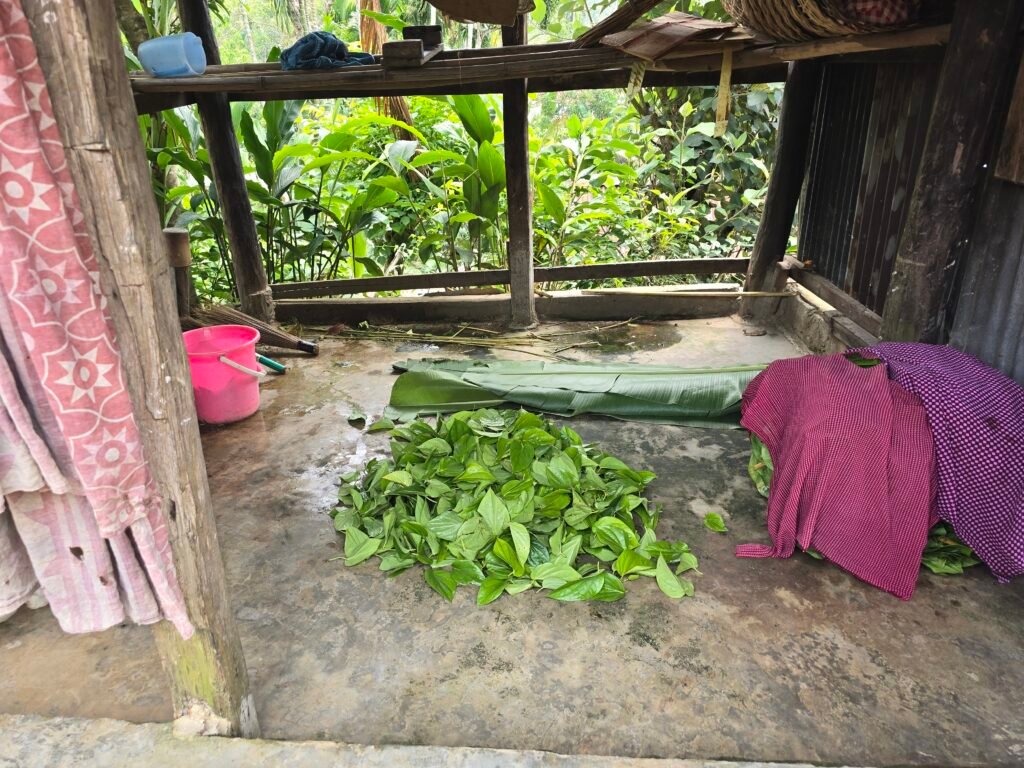
The Intergovernmental Panel on Climate Change confirms that South Asia is experiencing more erratic and extreme rainfall patterns, directly affecting smallholder agriculture systems and climate sensitive livelihoods.
For Khasi communities, this is not an abstract climate projection. It is already reshaping the forest economy.
Betel leaf cultivation here is a forest based agroforestry system where vines grow under natural canopy without land clearing. It depends on stable humidity, forest shade, and predictable rainfall cycles. Research on Khasi indigenous land use systems shows that this production model is highly dependent on environmental stability, where even small shifts in microclimate directly affect yield and quality.
In Kalinji Khasi Punji in Moulvibazar, farmer Hasina Tongper describes the change, “Earlier we knew when to harvest. Now everything has become unpredictable.”
Too much rain causes vine rot. Long dry spells reduce growth and leaf quality. Production cycles are no longer stable. They fluctuate sharply with weather patterns.
Field based agricultural studies in the Sylhet region show that rainfall irregularity, particularly excess rain during peak cultivation periods, leads to crop damage, disease pressure, and reduced productivity in rain dependent farming systems.
This environmental instability quickly turns into economic instability.
In Sreemangal and greater Moulvibazar, around 75 to 90 percent of Khasi household income comes from betel leaf cultivation, making it the primary livelihood base.
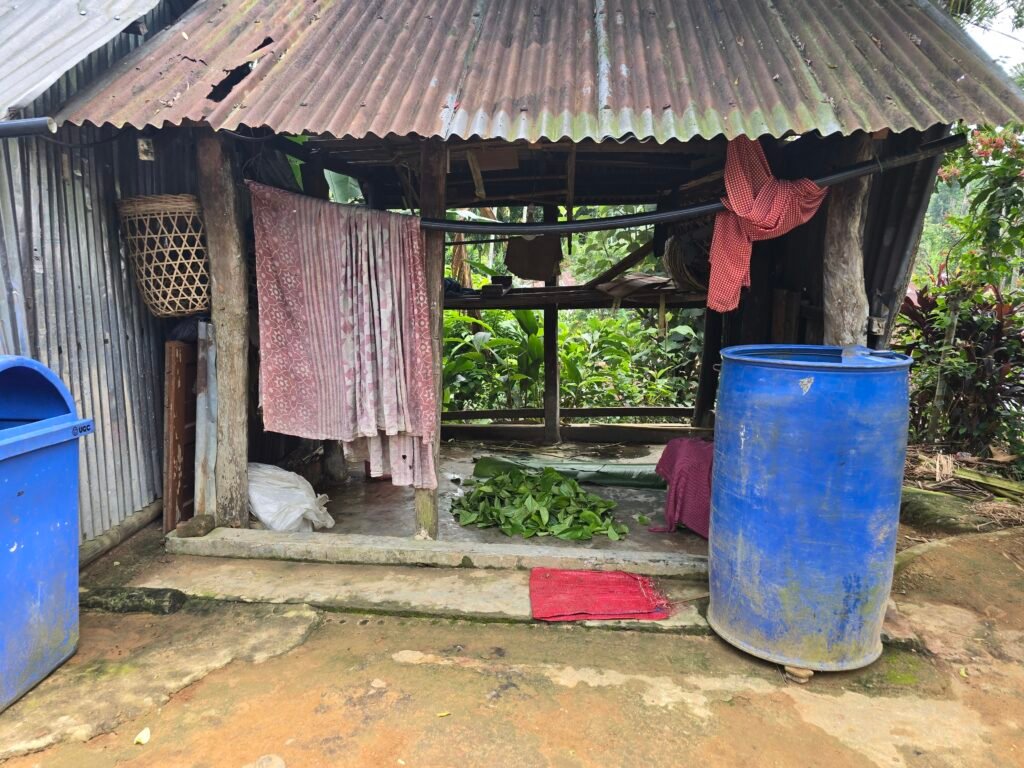
A standard unit of betel leaf, locally known as a kuri containing 2880 leaves, sells for 800 to 1000 Bangladeshi Taka in stable conditions. During climate related disruptions or oversupply periods, the price can fall to 200 to 300 Taka. The same labour suddenly produces far less income.
Economic research on agricultural systems confirms that rainfall variability does not only reduce production but also increases price volatility by destabilising supply chains and market structures.
This creates a double shock for Khasi women. Production becomes uncertain and income becomes unstable at the same time.
Market structure deepens this vulnerability. Khasi farmers depend on intermediaries for selling their produce, which limits direct market access and reduces bargaining power. This makes them highly exposed to price fluctuations.
In Kalinji Khasi Punji, community head Nit Khieriam explains, “Betel leaf is not just income here. It is the only source of income. There is no alternative livelihood.”
A woman farmer, Rirem Khongla, adds, “Everything depends on this garden. Without betel leaf, we have nothing.”
Because of this dependency, even short term production disruptions immediately break household cash flow. Income depends on frequent harvesting and weekly sales. A few weeks of disruption means income stops completely.
There is no alternative economic base to absorb these shocks. The land cannot easily support other crops, and forest clearing is not culturally or ecologically viable. This creates a structural absence of fallback livelihoods.
Field observations show that households respond by reducing consumption, prioritising essential expenses, and relying on informal credit or advance selling. Over time, repeated climate shocks turn into long term economic insecurity.
Within this system, women carry the highest burden. Khasi society is matrilineal, where women own land, manage production, and control household income. This means they also absorb both climate and market shocks directly.
Yet this system also has an ecological dimension.
Khasi betel leaf cultivation is an environmentally significant agroforestry practice. It preserves forest canopy, maintains soil moisture, and reduces pressure on deforestation. Research by MARIANG highlights that such systems also contribute to small scale carbon storage and ecosystem stability.
In other words, Khasi women are not only sustaining households, they are also sustaining a fragile forest ecosystem.
But that system itself is now under pressure.
Climate variability, single crop dependency, market constraints, and lack of livelihood diversification are combining into a structural vulnerability. What was once a stable rain dependent economy is becoming increasingly fragile under shifting monsoon patterns.
As one Khasi woman in Sreemangal puts it, “We still have land. But we no longer have control over the rain.”
Amid this uncertainty, the Khasi community continues to survive, where changes in the sky are now directly reshaping the economy on the ground.